
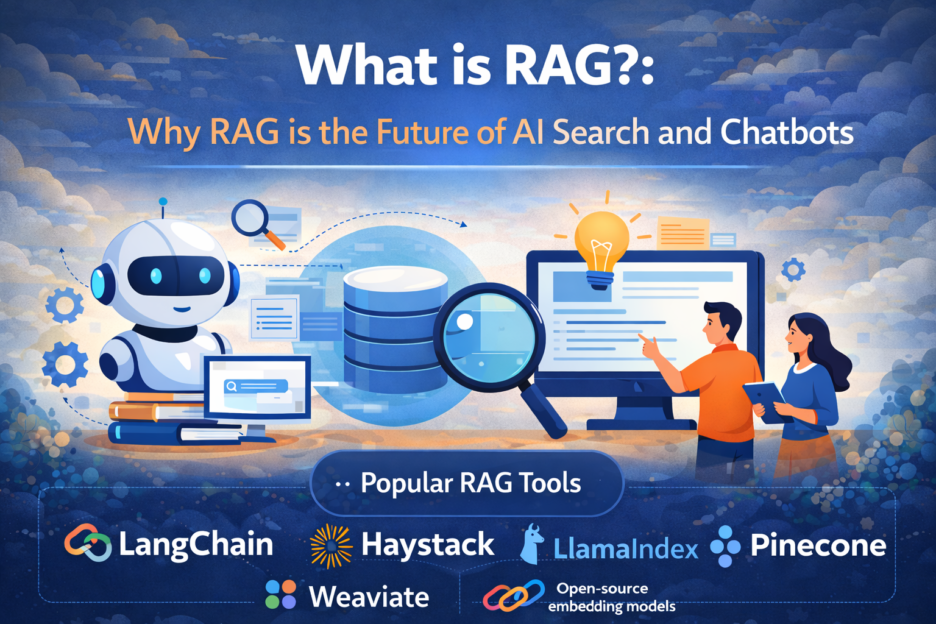
RAG (Retrieval-Augmented Generation) is an AI technique that improves answers by combining a language model with real-time data retrieval.
In simple terms, it lets AI look up fresh, relevant information before responding, making outputs more accurate and trustworthy.
What is RAG (Retrieval-Augmented Generation)?
RAG is a hybrid AI approach that combines:
- Retrieval System → Finds relevant information
- Language Model (LLM) → Generates the final answer
Simple Definition:
RAG = Search + AI Generation working together
Instead of guessing, the AI first retrieves facts, then creates an answer based on those facts.
Why RAG is the Future of AI Search and Chatbots
RAG (Retrieval-Augmented Generation) is the future because it makes AI more accurate, up-to-date, and trustworthy.
Instead of guessing, RAG-powered systems pull real-time information from trusted sources before generating answers. This means fewer errors, less hallucination, and more relevant responses.
Key Reasons:
- Real-time answers → No outdated information
- Higher accuracy → Uses verified data sources
- Better user experience → More relevant and helpful replies
- Custom knowledge → Works with private company data
- Scalable AI systems → Ideal for chatbots and search engines
In short: RAG turns AI search and chatbots into smart assistants that know, not guess.
How RAG Works (Step-by-Step Guide)
Let’s break it down into simple steps
- User asks a question
Example: “Best AI tools in 2026?” - Query is processed
The system understands intent and converts it into a search query. - Retrieve relevant data
It searches documents, databases, or the web for useful information. - Add context to AI
The retrieved data is given to the AI as reference material. - Generate answer
The AI combines its knowledge + retrieved data to create a response. - Final output
User gets a more accurate, up-to-date answer.
Simple Flow:
Query → Retrieve → Add Context → Generate Answer
How to Use RAG (Retrieval-Augmented Generation) – Simple Beginner Guide
To use RAG, you connect your data (documents, PDFs, or database) to an AI model so it can fetch relevant information before generating answers.
In short: Upload data → Retrieve relevant info → Generate smart answers.
Step-by-step:
- Prepare your data
Upload documents, PDFs, website content, or databases. - Convert to embeddings
Turn your data into vectors using embedding models. - Store in a vector database
Use tools like Pinecone, Weaviate, or FAISS. - User asks a question
Example: “Best SEO strategies in 2026?” - Retrieve relevant data
System searches your database for matching content. - Generate answer with AI
LLM (like GPT) uses retrieved data to give a precise answer.
Popular RAG Tools & Frameworks (2026)
If you want to build or use RAG systems, these tools are trending:
- LangChain
- LlamaIndex
- Haystack
- Pinecone (vector database)
- Weaviate
- Open-source embedding models
These tools help connect data with AI models easily.
Benefits of RAG (Retrieval-Augmented Generation)
RAG is one of the biggest AI upgrades in recent years. Here’s why:
- Scalable – Easily adapts to growing data and use cases
- More Accurate Answers – Uses real data instead of guessing
- Up-to-Date Information – Fetches the latest content in real time
- Reduces AI Hallucinations – Less fake or misleading outputs
- Uses Custom Data – Works with your own documents or databases
- Better User Experience – More relevant and useful responses
- Cost-Effective – No need to retrain models frequently
RAG vs Fine-Tuning (Quick Comparison)
| Feature | RAG | Fine-Tuning |
|---|---|---|
| Data Update | Real-time | Static |
| Cost | Lower | Higher |
| Flexibility | High | Limited |
| Use Case | Dynamic data | Specific behavior |
In 2026, many systems use RAG + Fine-tuning together for best results.
FAQs
1. What does RAG stand for in AI?
RAG stands for Retrieval-Augmented Generation, a method that combines data retrieval with AI-generated responses.
2. How is RAG different from ChatGPT?
RAG enhances AI like ChatGPT by adding real-time data retrieval, making answers more accurate and updated.
3. Is RAG better than fine-tuning?
RAG is better for dynamic data, while fine-tuning is better for fixed tasks. Many systems use both together.
4. Can beginners use RAG?
Yes, beginners can use tools like LangChain or LlamaIndex to build simple RAG applications without deep coding.
5. Where is RAG used in real life?
RAG is used in chatbots, search engines, healthcare AI, customer support, and enterprise knowledge systems.
Conclusion
RAG is not just a trend—it’s becoming the standard way AI systems work. By combining real-time data with powerful language models, RAG makes AI:
- More reliable
- More useful
- More human-like
If you’re building AI tools, writing content, or working in tech, understanding RAG is a must in 2026.
RAG turns AI from a “guessing machine” into a knowledge-powered assistant.